Most companies become AI-enabled before they become AI-native.
That usually starts in a pretty practical way: give people access to good tools. Let teams use ChatGPT, Claude, Claude Code, Codex, Cursor, Perplexity, and whatever else fits their work. This is often easy to implement, does not require changing existing workflows, and still makes people more productive. Sales teams prep faster for calls. Engineers ask better questions of a codebase. Support teams turn messy customer notes into cleaner summaries. Operators draft weekly updates without spending hours gathering context.
This first phase is useful because it lets the company discover where AI actually helps. You do not need to know the perfect workflow in advance. Give people the tools, let them use them in the work they already do, and pay attention to where the gains show up.
But access only gets you so far. After the first wave of obvious gains, more subscriptions and more tokens stop being the main constraint. The harder question becomes whether the company can take the useful work people are discovering and make it repeatable for everyone else.
That is the shift we wrote about in How to Think About AI as We Measure Outcomes Versus Token Spend. Tokens tell you the meter ran. Outcomes tell you whether the work mattered. Before companies can measure those outcomes well, they need to move from individual AI access to shared AI workflows.
The risk is AI sprawl. A few power users discover valuable workflows, but the learning stays trapped in private chats, local prompts, and personal setups. The best account research process lives with one account executive. The best support triage workflow lives with one support lead. The best code review checklist lives in one engineer's local routine. The company is building useful AI behavior, but it is not turning that behavior into company-specific best practices.
So the question is not how to become fully AI-native overnight. It is how to get started in a way that slowly figures out what AI can augment and how to get there depending on how your company works.
Step 1: Give People Access and Watch Where Leverage Appears
The first move is giving teams access to the AI tools they are going to use anyway. The important thing is to do this with enough basic guidance that people know what not to paste into tools, which systems are approved, and where to ask questions. It should feel lightweight. The goal is not to redesign everyone's job on day one.
Once people have access, look for repeated work. Where are people using AI more than once? Who is getting noticeably better results? What context are they pulling in? What does a good output look like? The answers will usually come from the people closest to the work, not from a top-down strategy exercise.
The power users matter because they know what good work looks like. A person does not become AI-native by asking a model to do everything for them. They become AI-native when they know a repeated task well enough to teach an assistant how it should be done, review the output, improve the process, and eventually trust it for more of the work.
The same is true for a company. Account research before sales calls, renewal risk summaries, support triage, meeting-note cleanup, weekly updates, pull request review, incident follow-up, competitive research, CRM cleanup: these are not glamorous, but they are exactly the kinds of workflows that start to matter when they happen hundreds of times.
Step 3: Make the Workflows Easier to Run Reliably
Once a workflow is useful enough that other people want to run it, the next job is to make it reliable enough that they can trust it.
A good workflow should not depend on someone remembering the perfect prompt every time. It should carry more of the work with it: the instructions, the context, the tools, the expected output, and the review points. If the workflow needs Salesforce context, it should know where to get it. If it needs to pull from Slack or Linear, that should be part of the workflow. If a human needs to approve the result before it goes to a customer, that should be built in.
This is where workflows start becoming more deterministic. The goal is not to make the agent rigid. The goal is to reduce the amount of improvisation required every time someone runs it. The more structure the workflow has, the easier it is for more people to use it and get a consistent result.
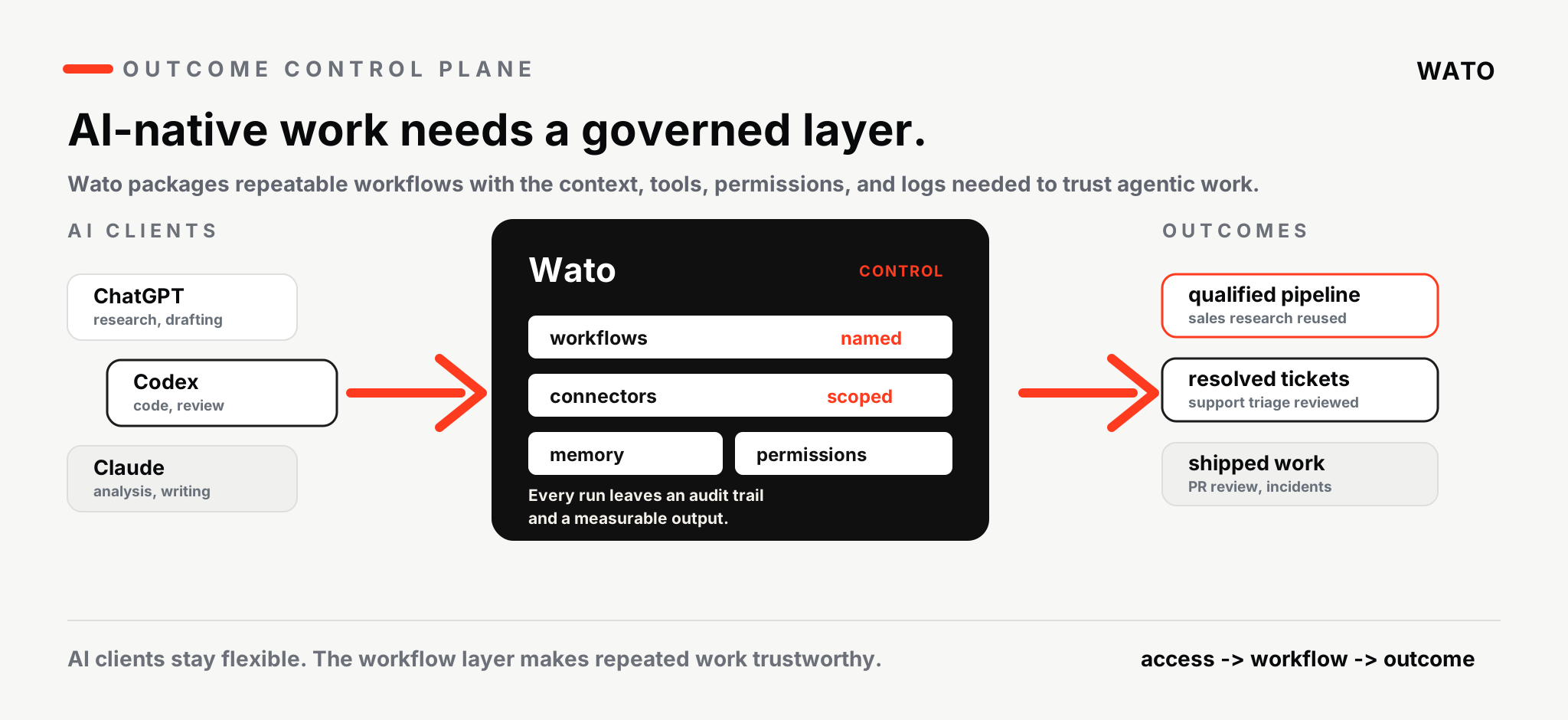
Wato helps by giving teams a way to package these workflows with the right context, connectors, memory, permissions, and audit trail. Instead of every person rebuilding the setup manually, the workflow can carry the company-specific instructions and context it needs to run well.
That does not mean ingesting every doc, Slack thread, and dashboard into one giant memory pile. Most company knowledge already lives in useful systems. The better move is to help agents find the right source, use the right connector, respect the right permissions, and leave behind a record of what happened.
The point is not "governance" for its own sake. The point is making the good workflows easier to share without losing trust.
Step 4: Measure the Workflow Itself
Once a workflow is being used by more than one person, you can start asking better questions.
How much work is AI actually doing? How much human review is still required? How much does the workflow cost to run? Are the outputs good enough? How many people are using it? Are they coming back to it? Is it saving time, improving quality, or helping the team produce more consistent work?
This is a much better level of measurement than looking at raw AI usage. Usage tells you people are trying the tools. Workflow-level measurement tells you whether a specific piece of work is getting better.
Wato can help here too, because the workflow is no longer invisible. You can start to see which workflows exist, who is using them, what systems they touch, how often they run, and whether the output is being reused or reviewed. That gives the company a better way to understand where AI is actually becoming part of the operating rhythm.
For sales, that might mean better account research, faster follow-up, or cleaner handoffs. For support, it might mean faster triage or better summaries for engineering. For engineering, it might mean cleaner pull request reviews or better incident writeups. For operations, it might mean weekly updates that no longer require hours of manual context gathering.
The goal is not to prove that AI is magically productive everywhere. The goal is to find the workflows where AI is doing meaningful work, understand what they cost, improve their quality, and get them into the hands of more people.
What AI-Native Should Mean
A company is not AI-native just because everyone has a chatbot open. It becomes AI-native when people can delegate real tasks and workflows to agents with trust.
That trust does not appear all at once. It is built company by company, workflow by workflow. First you understand what the company already does. Then you find the repeated work where AI is helping. Then you turn the best patterns into shared workflows. Then you add the context, tools, permissions, memory, and review steps that make those workflows reliable enough for more people to use.
That is the practical difference between AI as a set of subscriptions and AI as part of how the company works.
The companies that get this right will not necessarily be the ones with the most aggressive AI policy or the biggest model budget. They will be the ones that let experimentation happen, identify the workflows that actually help, and make those workflows easier for the rest of the organization to use.
A Practical Path to Start
Start by giving teams access to useful AI tools with basic boundaries around data and approved systems.
Watch for power users who are getting repeated value from AI in real work.
Turn their best workflows into shared skills, playbooks, workbooks, or templates.
Add the context, connectors, permissions, memory, and review points that make those workflows reliable enough for more people to use.
Measure each workflow by how much work AI is doing, how much it costs, how good the output is, and how many people actually use it.
That is how a company starts moving from AI access to AI-native work. Not by forcing a massive transformation all at once, and not by pretending that buying tools is enough. By turning the best of what people discover into shared workflows the company can improve over time.