Most companies are still trying to make AI agents better by giving them more. More context. More tools. More documents. More memory. Longer context windows. Bigger models. The assumption is understandable: if the agent is missing something, the answer must be to give it access to more of the company.
But at work, more is often the thing that makes agents slower, noisier, and harder to trust.
The next frontier for AI agents is not just intelligence. It is efficiency. An efficient agent does not search every connected system just because it can. It does not read ten stale documents when one reviewed source would do. It does not ask a human to restate context that already exists somewhere in the company. It does not produce an impressive-looking answer that has to be rewritten by a teammate. It gets the right context for the specific job, uses the right workflow, and produces something useful with as little wasted motion as possible.
That is a different problem than company memory. Company memory asks what knowledge should be reviewed, stored, permissioned, and made durable. Agent efficiency asks a narrower operating question: for this task, what does the agent actually need to know, where should it look, what should it ignore, and how much human cleanup should the output require?
More Context Is Not Always Better Context
The instinct to connect everything is strong because most companies know their knowledge is scattered. Sales context might live in Salesforce, call notes, email, Slack, and account plans. Engineering context might live in GitHub, Linear, incidents, runbooks, and old decisions. Product context might live in roadmaps, customer notes, analytics, research calls, and planning docs. It feels natural to solve this by giving the agent access to all of it.
The problem is that broad access does not automatically create good judgment. If the agent has ten possible sources for a customer issue, it still has to know which one is authoritative. If there are three versions of a process, it still has to know which one is current. If a Slack thread includes a proposed direction and a later document includes the final decision, it still has to understand the difference between discussion and truth.
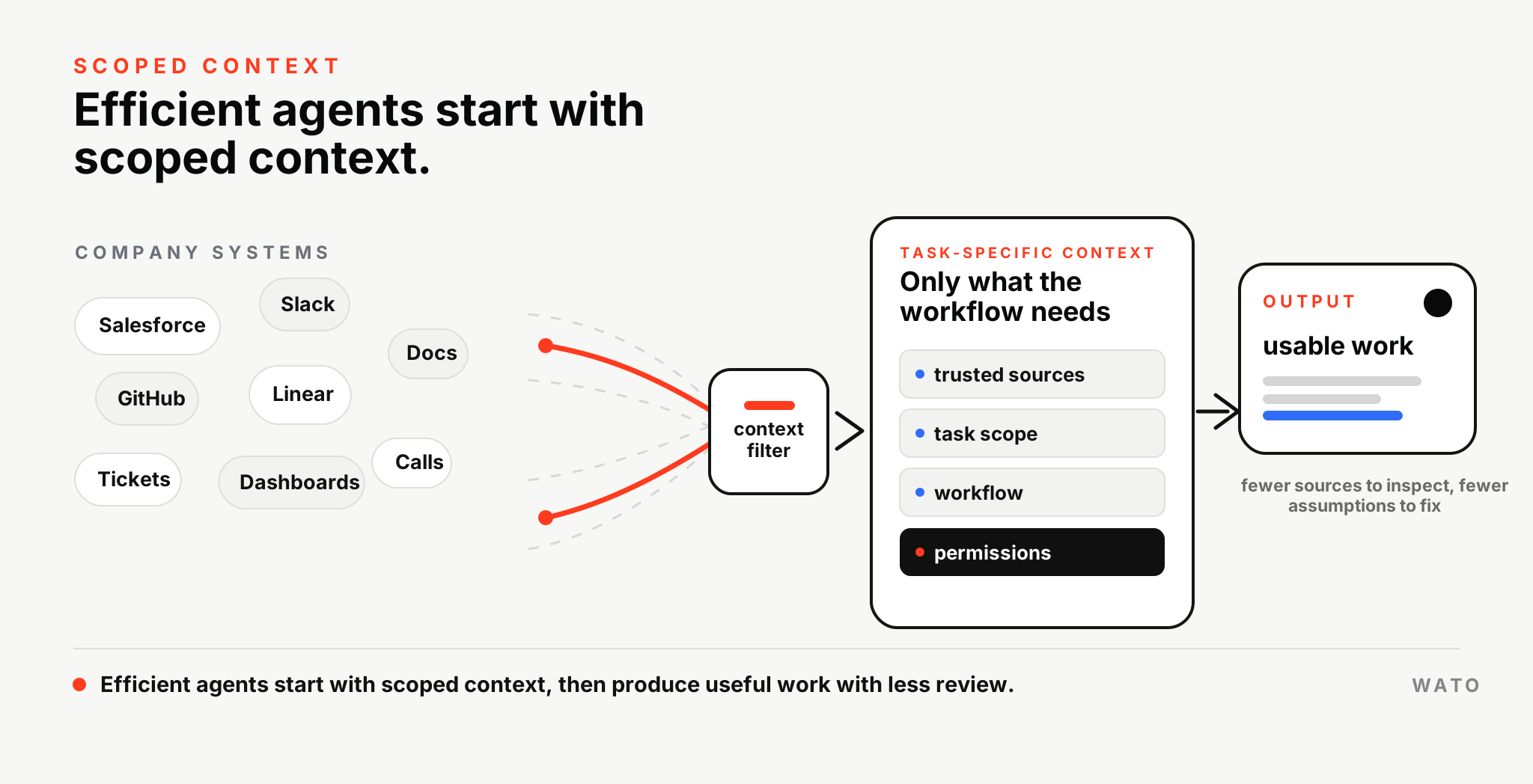
Efficient agents need scoped context, not maximum context. A support triage workflow should retrieve the customer record, recent tickets, known incidents, the relevant product area, escalation rules, and response standards. It should not wander through every document that happens to mention the customer. An account research workflow should pull the account record, recent calls, open risks, renewal status, implementation notes, and the sales team's preferred brief format. It should not summarize every conversation ever associated with the account.
The goal is to reduce the agent's search space before the model starts reasoning. When the search space is smaller and better labeled, the agent spends less time sorting through noise and more time producing work that can actually be used.
The Best Agents Know What To Ignore
A useful agent setup should define negative space. It should not only tell the agent where to look; it should tell the agent what not to look at. That is where a lot of efficiency comes from.
For example, if engineering decisions are captured in reviewed architecture notes, the agent should treat old Slack debates as background rather than authority. If renewal status lives in Salesforce, the agent should not infer it from scattered call notes unless the workflow says to do so. If implementation risk is tracked in a support system, the agent should start there instead of searching across every customer mention in the company.
This sounds simple, but it changes the quality of the work. Without these boundaries, the agent has to rediscover the company's operating model every time it runs. With them, the agent can act inside a known frame. It knows which sources are canonical, which are supplemental, which actions require review, and what output format the team expects.
That is why the most efficient agent workflows often feel less open-ended than a general chat prompt. They are more constrained. They route the model toward the right context, right tools, and right deliverable. The model still reasons, but it reasons inside a shape the company trusts.
Turn Repeated Work Into Efficient Workflows
The easiest place to improve agent efficiency is repeated work. Most teams already have tasks that happen again and again: meeting prep, customer research, support triage, onboarding, bug investigation, renewal reviews, weekly updates, competitive research, and internal reporting. These tasks are not difficult because every instance is unique from first principles. They are difficult because the company context is scattered and the process lives in someone's head.
A good workflow makes the repeated parts explicit. It defines the input, the sources to check, the sources to ignore, the tools to use, the permission boundaries, the review points, and the expected output. This turns an agent from a general assistant into something closer to a repeatable operator. It also makes the work easier to evaluate because a reviewer can ask whether the agent followed the workflow, not merely whether the answer looks good.
Consider the difference between "research this customer" and "use Salesforce for account status, approved call notes for recent conversations, Zendesk for open issues, Linear for active product commitments, and the renewal playbook for next steps. Produce a one-page account brief with risks, open questions, and recommended follow-up actions." The second version is not just a better prompt. It is a more efficient operating environment. The agent has fewer choices to make before doing useful work, and the human has fewer assumptions to verify afterward.
What Companies Should Measure
If the goal is efficiency, companies should not only measure whether people are using AI. Usage is a weak proxy. A team can increase agent runs and still waste time if those runs require heavy correction or produce outputs nobody trusts. The better question is whether agents are reducing the amount of work required to reach a useful outcome.
That means looking at practical measures: how many clarifying turns were needed, how often the agent used the right source of truth, how much human editing was required, how often the output was reused, how long the workflow took end to end, and whether the result moved a real business process forward. For a support workflow, the outcome might be faster triage or fewer escalations. For sales, it might be better account briefs or more consistent follow-ups. For engineering, it might be faster onboarding, cleaner bug summaries, or fewer repeated questions.
This is also where governance and efficiency start to reinforce each other. Permissions, reviewed workflows, connector boundaries, and audit logs are often framed as risk controls. They are that, but they also make agents faster. When the agent knows what it can access, what it can do, what requires approval, and what source is trusted, it wastes less time operating in ambiguity.
Where Wato Fits
Wato is positioned around this efficiency problem because it sits between AI clients and the company systems where work actually happens. The point is not to copy the whole company into a new database or force every team to abandon the tools they already use. The point is to make those tools easier for agents to use correctly.
In practice, that means giving agents access to connectors, workflows, reviewed memory, permissions, and audit logs in one operating layer. The connector tells the agent how to reach the system. The workflow tells it what to do. The memory tells it what the company has already reviewed. The permission layer tells it what it is allowed to access or change. The audit log makes the work inspectable after the fact.
That combination matters because agent efficiency is not solved by the model alone. A better model can reason more effectively, but it still needs an organized path through the company. Without that path, it burns time navigating the organization. With that path, it can focus on the actual task.
The Goal Is Less AI Busywork
The best AI setup is not the one with the most tools connected or the largest possible context window. It is the one where agents can complete useful work with the least wasted search, least irrelevant context, least human correction, and clearest path to a business outcome.
That requires a shift in how companies think about adoption. The first wave of AI at work was about giving people access to better models. The next wave is about making the surrounding workspace efficient enough for agents to operate inside it. That means narrowing context by task, turning repeated work into workflows, making trusted sources obvious, and giving agents permissioned access to the systems where work happens.
Companies do not need perfectly clean knowledge management to get value from agents. They need enough structure that the agent is not forced to rebuild the company's operating model every time it runs. When agents know where to look, what to ignore, what workflow to follow, and what outcome they are driving toward, AI stops feeling like another layer of busywork and starts behaving more like infrastructure for getting work done.